You must have seen those reels by now. Someone holds up a post office board and says, “Put your money here and it will double, guaranteed by the Government.” Most of the time they are talking about Kisan Vikas Patra. The claim is true, but only half the story is told in a 30 second video. How long does it take? Is the interest taxable? Can you take the money out in an emergency? These are the questions that actually matter before you put in your hard earned savings.
In this guide, I will explain Kisan Vikas Patra in simple words. You will see the latest interest rate for October to December 2026, exactly how the money doubles, who can open an account, how to open one at the post office, the tax rules, and how it compares with other post office schemes. By the end, you will know clearly whether this scheme suits you or not.
What Is Kisan Vikas Patra?
Kisan Vikas Patra, usually called KVP, is a small savings scheme run by the Government of India through India Post. It was first started in 1988, and the idea is very simple. You deposit a lump sum once, and after a fixed period your money becomes double. You don’t have to deposit anything every month.
The word “Kisan” means farmer, and the scheme was originally created with rural families in mind. Today, though, any eligible Indian resident can invest in Kisan Vikas Patra, whether you are a farmer, a salaried employee, a shop owner or a homemaker. If you are curious about how the scheme started and changed over the years, the Kisan Vikas Patra page on Wikipedia has a short history.
Since the Government backs it, your money is very safe. There is no stock market risk and no fear of the company shutting down. That is the main reason many families, especially elders, trust this scheme more than anything else.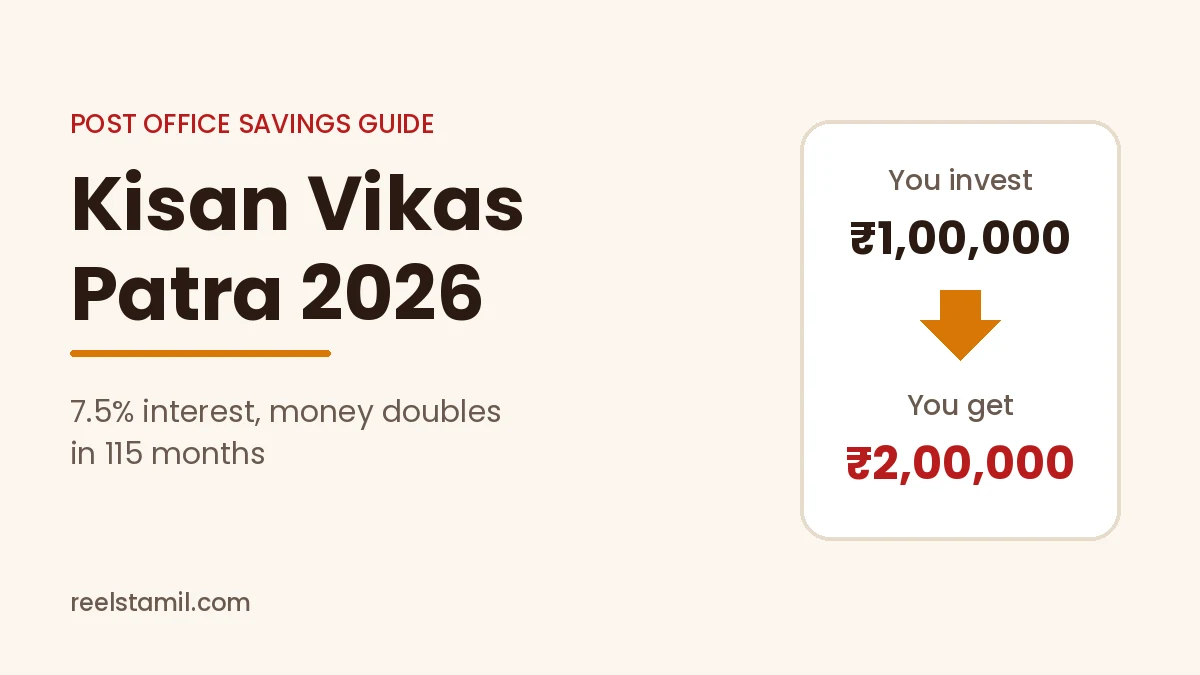
Kisan Vikas Patra Interest Rate for October to December 2026
The Government reviews small savings interest rates every quarter. On 30 September 2026, the Finance Ministry announced that rates would stay unchanged for the October to December 2026 quarter.
So the current Kisan Vikas Patra interest rate is 7.5 percent per year, compounded yearly. At this rate, your money doubles in 115 months, which is 9 years and 7 months. This rate has been the same since 1 April 2023.
One important point. The rate that applies to you is the rate on the day you open the account. Even if the Government cuts rates in the future, your account will continue at the rate you got when you invested, till maturity. That certainty is one of the biggest plus points of KVP.
How Kisan Vikas Patra Doubles Your Money
Let’s understand this with a simple example. Say you invest ₹1,00,000 in Kisan Vikas Patra today. Every year, 7.5 percent interest is added, and the next year’s interest is calculated on the bigger amount. This is called compounding.
After about 3 years, your ₹1 lakh grows to roughly ₹1.24 lakh. By year 5, it is around ₹1.44 lakh. By year 9, it is close to ₹1.92 lakh, and at 115 months you receive ₹2,00,000. If you invest ₹50,000, you get ₹1,00,000. If you invest ₹10,000, you get ₹20,000. The rule is the same for any amount.
Also note that if you don’t withdraw the money on the maturity date, it does not stay idle forever with full interest. Check with your post office what interest applies after maturity, and plan to collect or reinvest on time.
Who Can Open a Kisan Vikas Patra Account?
KVP is open to Indian residents. Here are the types of accounts allowed under the scheme.
A single holder account can be opened by any adult in their own name. An adult can also open one on behalf of a minor or a person of unsound mind for whom they are the guardian. A minor who has completed 10 years of age can open an account in their own name.
A joint account can be opened by up to three adults. There are two types. In a Joint A account, the money is paid to all holders together or to the survivors. In a Joint B account, the money can be paid to any one of the holders or to the survivors.
Non-resident Indians (NRIs) and Hindu Undivided Families (HUFs) are not allowed to invest in Kisan Vikas Patra. There is no limit on the number of accounts one person can open.
How Much Can You Invest in Kisan Vikas Patra?
The minimum deposit is ₹1,000. After that, you can invest any amount in multiples of ₹100. There is no maximum limit, so you can invest as much as you want.
However, a few extra checks come in for bigger amounts, as part of the rules against money laundering. If you invest more than ₹50,000, you must give your PAN card. If you invest ₹10 lakh or more, you also need to show proof of the source of income, such as bank statements, salary slips or your income tax return.
This is actually a good thing. It keeps the scheme clean and makes sure your investment is properly recorded in your name. 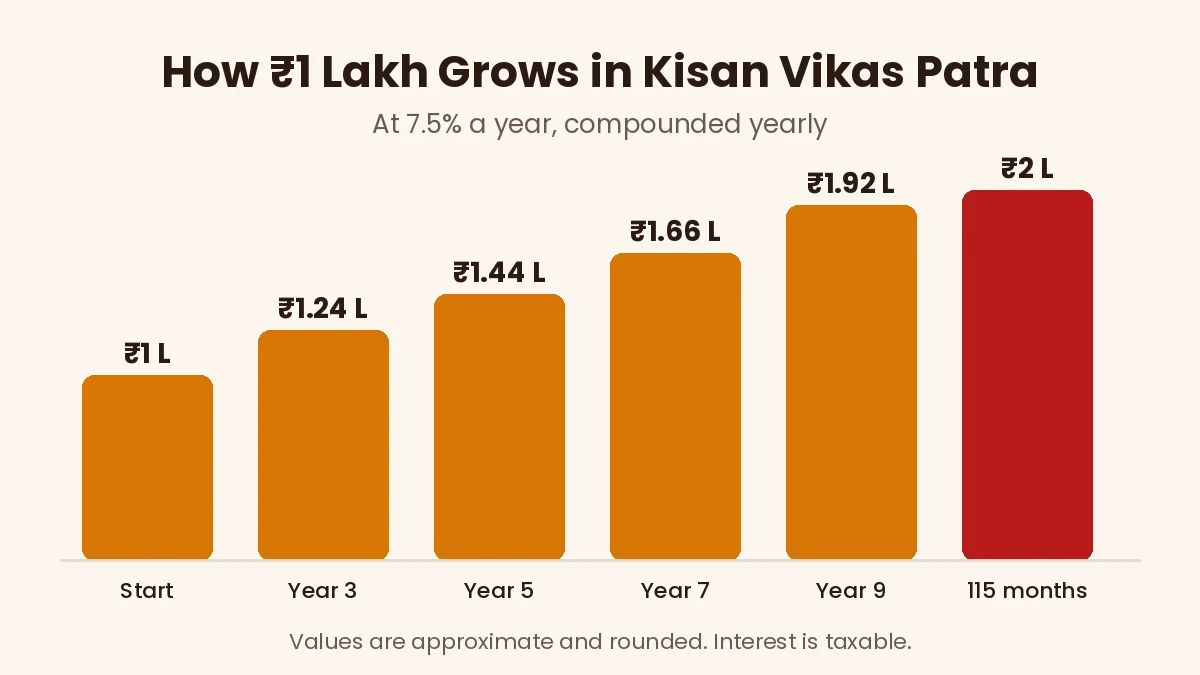
Documents Needed for Kisan Vikas Patra
The paperwork is quite simple. Keep these ready before you visit the post office.
You will need the account opening form, which you can get at the post office counter. You will need your Aadhaar card and a recent passport size photograph. If your investment is above ₹50,000, carry your PAN card. For ₹10 lakh and above, carry your income proof. For an account on behalf of a minor, carry the child’s birth certificate along with the guardian’s documents.
It is also a good idea to carry a cancelled cheque or your bank passbook, as some post offices like to link the payout to your bank or post office savings account.
How to Open a Kisan Vikas Patra Account at the Post Office
Opening a KVP account takes just one visit if your documents are ready.
Step 1: Visit Your Nearest Post Office
Go to any post office that handles savings schemes. Most head post offices and sub post offices do. Some authorised banks also offer Kisan Vikas Patra, so you can ask at your bank branch as well.
Step 2: Fill the Account Opening Form
Ask for the KVP account opening form. Fill in your name, address, the type of account (single or joint), the amount, and your nominee’s details. Take a minute to fill the nominee part carefully, because it makes things much easier for your family later.
Step 3: Submit Your Documents and Pay
Attach copies of your KYC documents and show the originals for verification. Pay the amount by cash, cheque or demand draft. If you pay by cheque, the account starts from the date the cheque is cleared.
Step 4: Collect Your Certificate or Passbook
Once the payment is done, you will receive your Kisan Vikas Patra certificate or account passbook. Check that your name, amount, date and maturity date are correct before leaving the counter. Keep this document safely, along with a photocopy at home.
If you already have a post office savings account with internet banking enabled, you may also be able to invest online. Ask your post office whether this facility is active for your account.
Can You Withdraw Kisan Vikas Patra Before Maturity?
Yes, but with conditions. KVP has a lock-in period of 2 years and 6 months from the date of deposit. After this period, you can close the account early, and you will get the amount as per the Government’s premature closure table, which is lower than the full maturity value.
Before 2 years and 6 months, early closure is allowed only in special cases. These are the death of the account holder or all joint holders, forfeiture by a pledgee who is a Gazetted Officer, or an order from a court. In such early cases, the payout is usually your principal with simple interest at the post office savings account rate.
So the honest advice is this. Invest only the money you are sure you won’t need for at least two and a half years, and ideally for the full 115 months. For emergencies, keep a separate fund in a savings account or a short term deposit.
Loan Against Kisan Vikas Patra
Here is a benefit many people don’t know about. You can pledge your Kisan Vikas Patra as security to get a loan. Scheduled banks, cooperative societies, the RBI, Government companies and approved housing finance companies are among those who can accept it as security.
Because the loan is backed by a Government scheme, banks usually treat it as a secured loan. Secured loans generally come at a lower interest rate than personal loans, which have no security. If you suddenly need money for a medical bill, a child’s admission or a small business need, this can be a cheaper option than breaking your investment or taking a high interest personal loan.
The exact loan amount and interest rate depend on the bank, so compare a couple of banks before deciding. Once you repay the loan fully, the pledge is removed and your KVP continues as usual.
Tax on Kisan Vikas Patra Interest
This is the part reels usually skip. The amount you invest in Kisan Vikas Patra does not get any tax deduction under Section 80C. And the interest you earn is fully taxable as per your income tax slab.
You have two ways to show this interest in your income tax return. You can show the interest earned every year as it accrues, or you can show the whole interest in the year you receive the maturity amount. Showing it every year spreads the tax over many years and usually avoids a big tax bill in a single year. Whichever method you choose, follow it consistently.
If you are in the zero tax bracket, like many retired people or homemakers with no other income, this tax point may not affect you much. But if you are in the 20 or 30 percent slab, your actual return after tax will be lower than 7.5 percent. This post is general information and not tax or investment advice, so do check with a tax consultant for your own situation.
Kisan Vikas Patra vs Other Post Office Schemes
KVP is not the only safe option at the post office. Here is how it compares with some popular schemes for October to December 2026.
The National Savings Certificate (NSC) gives 7.7 percent and has a shorter 5 year period. Unlike Kisan Vikas Patra, the NSC investment qualifies for the Section 80C tax deduction. If you want to save tax, NSC is usually the better choice.
The Public Provident Fund (PPF) gives 7.1 percent. Its rate is lower, but both the investment and the interest are tax free, which makes it very attractive for people in higher tax slabs. The catch is the long 15 year lock-in and the yearly investment limit.
The 5 year Post Office Time Deposit gives 7.5 percent, the same as KVP, and also offers 80C benefit on the deposit. The Senior Citizens Savings Scheme and Sukanya Samriddhi both give 8.2 percent, but they are only for senior citizens and for the girl child respectively.
So where does Kisan Vikas Patra fit? It is best when you have a lump sum, don’t need regular income from it, and want a simple, guaranteed “double in a fixed time” plan without any investment limit.
Who Should Choose Kisan Vikas Patra?
KVP suits people who want complete safety and don’t want to track markets at all. It works well for parents planning a goal about 10 years away, like a child’s higher studies or marriage. It also suits retired people and homemakers who have a lump sum and are in the lower tax brackets.
It may not be the best fit if you want tax savings, because there is no 80C benefit. It may also not suit you if you need monthly income, since the money comes only at maturity. And if you are young and can handle some ups and downs, you may want to keep only part of your savings in Kisan Vikas Patra and invest the rest in options that may grow faster over the long term.
A balanced approach works for most families. Keep an emergency fund in a savings account, take health insurance and term insurance for protection, and then use schemes like KVP for safe, long term goals. Gold is another traditional choice for many Tamil families, and if you buy jewellery, our guide on checking if your gold is original with the BIS CARE app will help you avoid getting cheated.
Common Mistakes to Avoid With Kisan Vikas Patra
The first mistake is not adding a nominee. If something happens to you, a missing nomination makes it much harder for your family to claim the money. It takes two minutes to fill, so never skip it.
The second mistake is putting your emergency money into Kisan Vikas Patra. Because of the 2.5 year lock-in, you cannot access it quickly. Keep your emergency fund separate.
The third mistake is forgetting about tax. Many people think a Government scheme means tax free returns. KVP interest is taxable, so plan for it.
The fourth mistake is trusting anyone who promises to double your money faster. Kisan Vikas Patra doubles money in 9 years and 7 months at the current rate. If someone offers to double it in one or two years, it is almost certainly a fraud. Similar fake promises go around in other areas too, like the rooftop tower rent offers we checked in our post on Jio tower installation and the ₹50,000 rent claim.
The fifth mistake is losing the certificate or passbook. Keep it in a safe place, and keep a photo and photocopy at home. 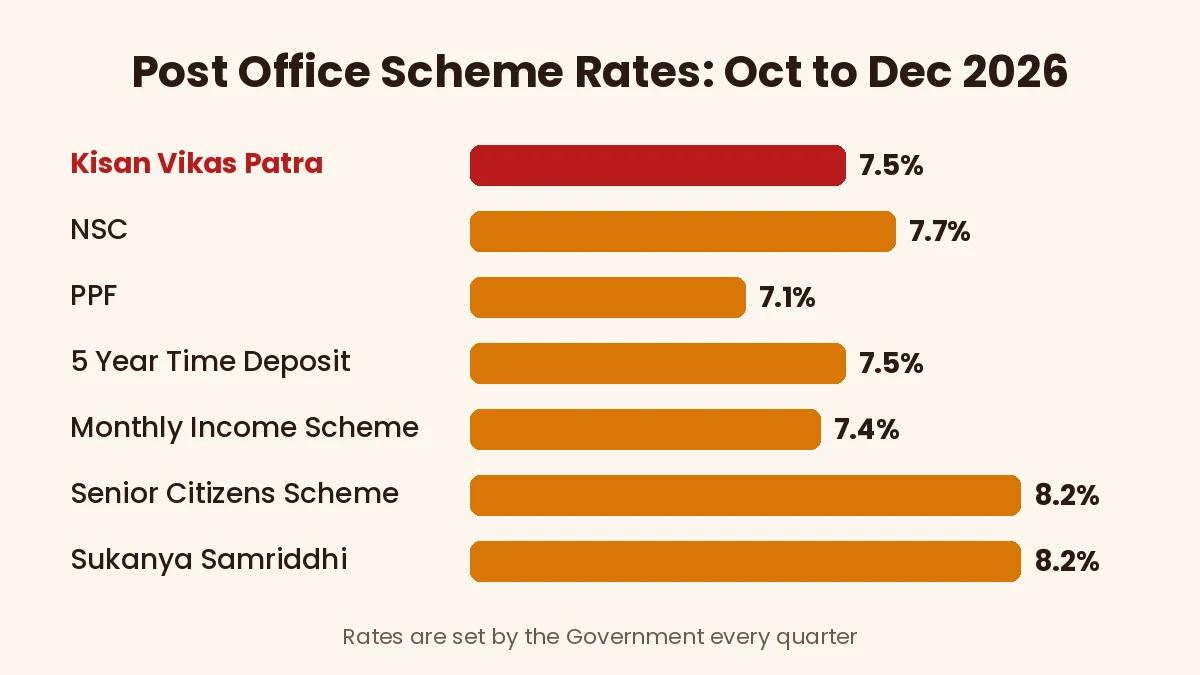
Frequently Asked Questions
What is the Kisan Vikas Patra interest rate now?
For the October to December 2026 quarter, the Kisan Vikas Patra interest rate is 7.5 percent per year, compounded yearly. At this rate, your money doubles in 115 months.
How many years does Kisan Vikas Patra take to double money?
At the current rate, it takes 115 months, which is 9 years and 7 months. The period depends on the interest rate at the time you open the account.
Is Kisan Vikas Patra tax free?
No. There is no Section 80C deduction on the investment, and the interest is taxable as per your income tax slab.
Can I close Kisan Vikas Patra early?
Yes, after 2 years and 6 months from the date of deposit, at a reduced value as per the Government table. Before that, early closure is allowed only on the holder’s death, forfeiture by a pledgee or a court order.
Can I take a loan against Kisan Vikas Patra?
Yes. You can pledge your Kisan Vikas Patra with a bank or other approved institution as security for a loan. The loan amount and interest rate depend on the lender.
Conclusion
Kisan Vikas Patra is one of the simplest and safest ways to grow a lump sum in India. At 7.5 percent, your money doubles in 9 years and 7 months, with the full backing of the Government. There is no upper limit, you can open it at any post office, and you can even take a loan against it if needed.
At the same time, keep the full picture in mind. The interest is taxable, there is no 80C benefit, and the money is locked in for at least two and a half years. If these points suit you, KVP can be a solid, worry free part of your family’s savings plan.
If you found this guide useful, you may also like our post on the native chicken and goat farming scheme in Tamil Nadu, another helpful Government scheme for rural families. And if you already have a Kisan Vikas Patra, share in the comments what goal you are saving for.