What Is the Tamil Nadu Solar Subsidy Scheme?
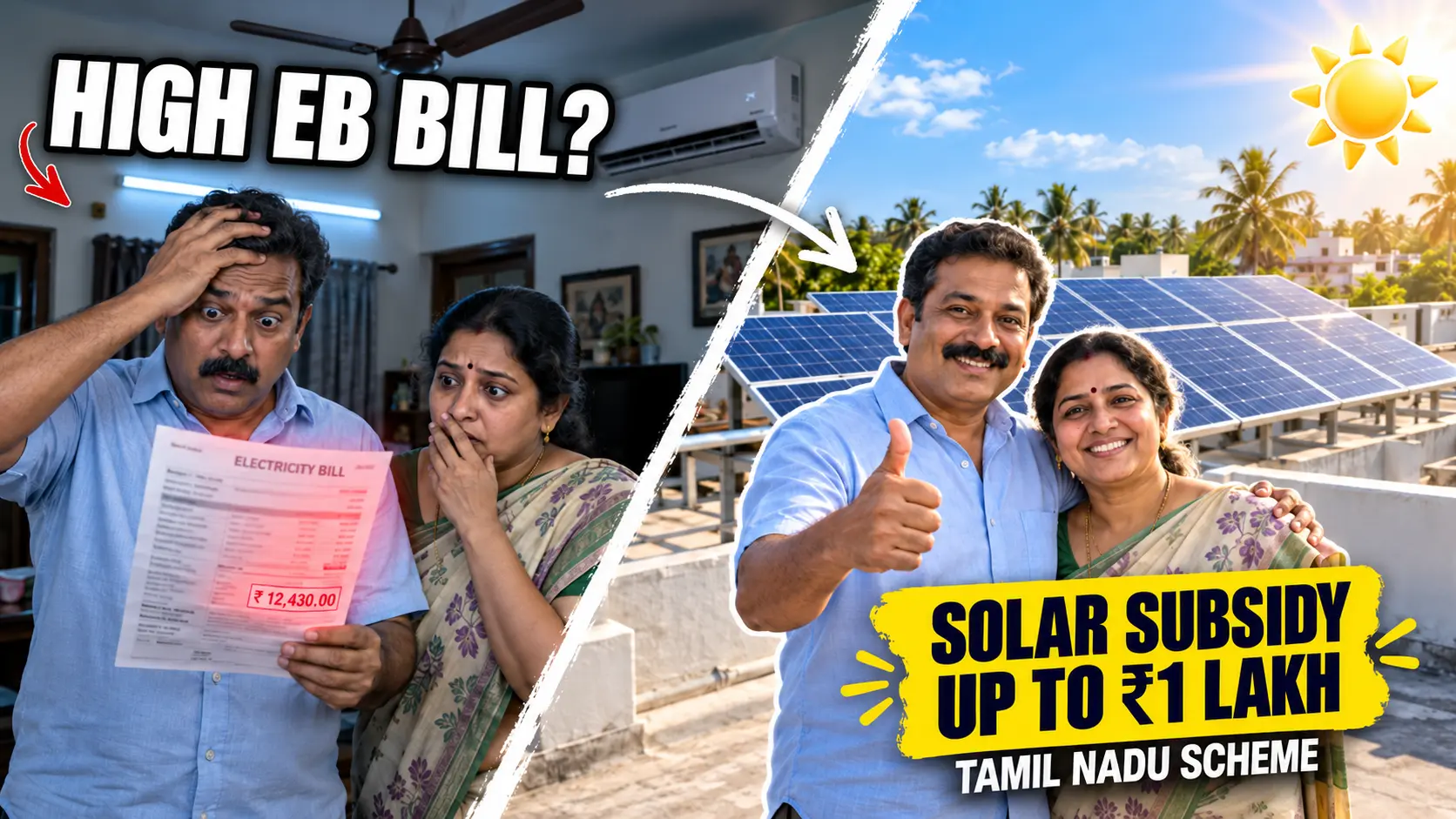
Before we get into the Tamil Nadu solar subsidy itself, know that the central government already runs the PM Surya Ghar scheme, which gives a subsidy to homes that install grid connected rooftop solar. In 2026, the Tamil Nadu government announced the Tamil Nadu solar subsidy, an extra state top-up on top of this central amount, so that families pay even less from their pocket. The state scheme was announced in the 2026-27 budget and formally launched in Chennai on 21 September 2026 by Energy Minister Nirmal Kumar through TNPDCL. As per reports, the Chief Minister announced a special allocation of ₹50 crore for this extra subsidy. Tamil Nadu is already one of the active states for rooftop solar, even before the Tamil Nadu solar subsidy top-up. As of July 2026, reports said the state had around 87,000 rooftop solar installations serving over one lakh households, including apartments. With the new state top-up, this number is expected to grow quickly, and that is exactly why it makes sense to understand the scheme early.How Much Tamil Nadu Solar Subsidy Will You Get?
The Tamil Nadu solar subsidy depends on the size of the system you install, measured in kilowatts (kW). Here is the break up as listed on the official Tamil Nadu solar rooftop portal.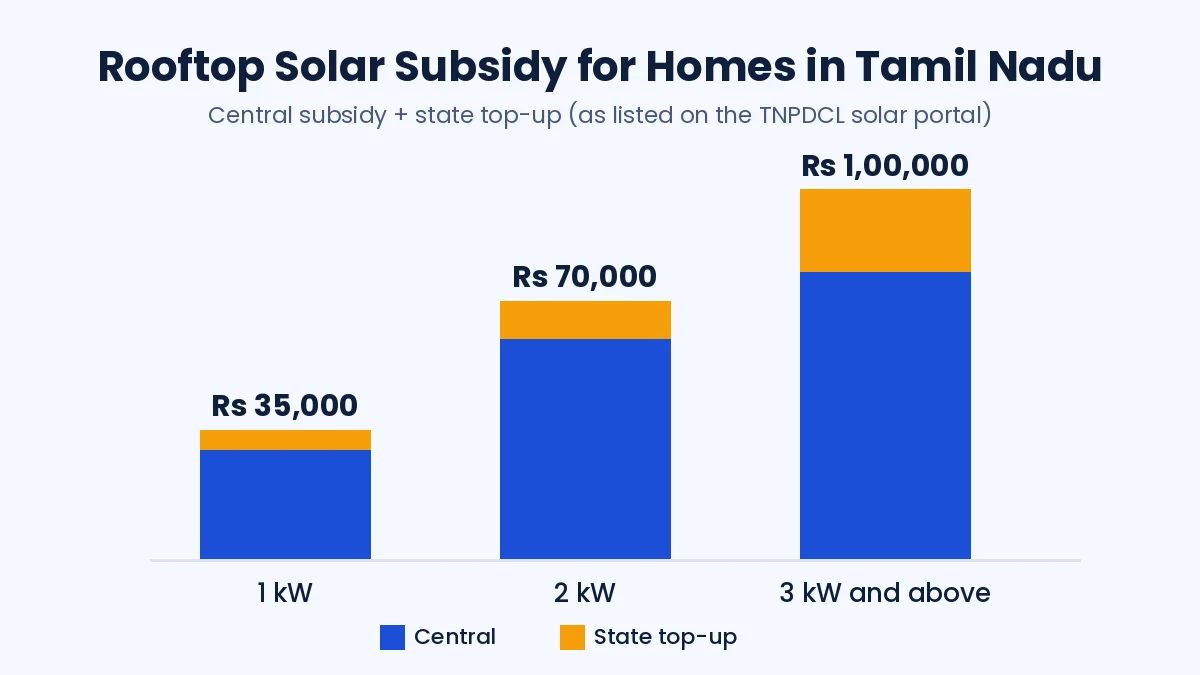
Who Can Apply for the Tamil Nadu Solar Subsidy?
Not every connection is eligible for the Tamil Nadu solar subsidy, so check these points before you spend any money. The scheme is for residential, domestic electricity connections only. Commercial, industrial and agricultural connections are not covered under this home scheme. For the state top-up, reports say you should have registered on the PM Surya Ghar portal on or after 5 August 2026, when the scheme was announced. Earlier applications may get only the central subsidy. The system must be connected to the grid with net metering. Off grid systems that work only with batteries are not eligible. You must use a vendor empanelled under the scheme, and the solar panels must meet the domestic content requirement and be listed in the approved list of models. In simple words, the panels must be Indian made and approved. Imported panels will not qualify. You need enough shadow free roof space. A rough thumb rule is about 100 square feet of open roof for every 1 kW. So a 3 kW system needs around 300 square feet without shade from trees, water tanks or nearby buildings. Reports also suggest the Tamil Nadu solar subsidy top-up is limited to a fixed number of applicants and a fixed budget, so the money may run out once enough people claim it. Don’t wait till the last minute if you are serious.How Much Can Rooftop Solar Really Save on Your EB Bill?
Beyond the Tamil Nadu solar subsidy, this is the question every family asks, so let’s do some simple, honest maths. In Tamil Nadu, a 1 kW rooftop system produces roughly 4 units of electricity a day on average, depending on sunlight, season and how clean the panels are. That is about 120 units a month, or around 240 units in a two month billing cycle. So a 3 kW system can produce roughly 700 units in a billing cycle. For a typical family using 400 to 600 units every two months, that can cover most or even all of the bill. With net metering, the electricity your panels produce during the day first runs your home. If you produce more than you use, the extra goes to the grid and is adjusted against what you take from the grid at night. You pay only for the difference. If you want to understand this system better, the net metering page on Wikipedia explains it clearly. There is another benefit that many people miss. In Tamil Nadu, crossing 500 units in a two month cycle means losing some free units and moving into higher tariff slabs. Solar can help keep your billed units below that line, which saves even more money than the units alone suggest. Every home is different, so treat these numbers as a rough guide. A good vendor should give you an estimate based on your actual roof and your last few EB bills.How to Apply for the Tamil Nadu Solar Subsidy, Step by Step
The Tamil Nadu solar subsidy process looks long, but most of the work after the first step is done by your vendor and TNPDCL. Here is how it works.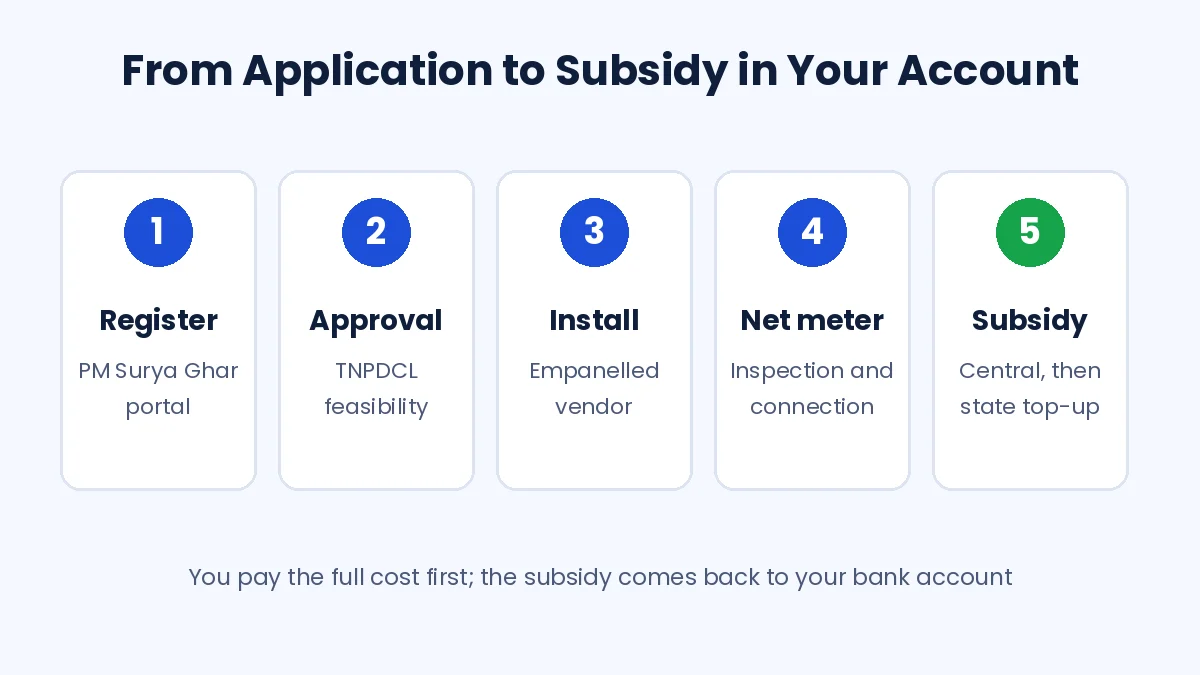
Step 1: Register on the PM Surya Ghar Portal
Go to the official PM Surya Ghar portal and register with your mobile number. Select Tamil Nadu as your state and choose your electricity distribution company. Enter your electricity service connection number exactly as printed on your EB card or bill.Step 2: Apply and Get Feasibility Approval
Fill in the rooftop solar application with the system size you want. TNPDCL will check whether your connection and transformer can handle the solar system and give technical feasibility approval. You will get an application reference number. Keep it safely.Step 3: Choose an Empanelled Vendor and Install
Pick a vendor from the empanelled vendor list on the portal. Get a written quote, check the panel and inverter details, sign the agreement and get the system installed.Step 4: Net Meter, Inspection and Connection
Once installation is done, the work completion details are submitted. TNPDCL inspects the system, fixes the net meter and connects your solar plant to the grid.Step 5: Receive the Subsidy
After commissioning, the central subsidy is credited to your bank account. Then the Tamil Nadu solar rooftop portal handles the Tamil Nadu solar subsidy top-up. As per the portal, the state amount is paid by direct bank transfer after verification, usually within 7 to 15 days of the central subsidy. You can track your application status on the state portal using your application number or mobile number.Documents to Keep Ready
Having these ready makes your Tamil Nadu solar subsidy claim much smoother. Keep a recent EB bill showing your service connection number, Aadhaar card, bank account details with a cancelled cheque or passbook copy, and a photo of your roof. After installation, the portal asks for the net meter agreement, a photo of the installed plant, the domestic content (DCR) details of the panels, and the state subsidy details. Your vendor usually helps with these uploads, but keep your own copies too.Paying for the System: Loans, EMI and Your Budget
Even with the Tamil Nadu solar subsidy, you need to pay the full amount upfront and wait for the money to come back. For many families, that is the hardest part. The good news is that many banks offer rooftop solar loans for homes under the PM Surya Ghar scheme, often at lower interest rates than personal loans. Ask your own bank first, since they already know your account history. Compare the interest rate, processing fee and loan tenure with one or two other banks before deciding. A simple way to decide is to compare the monthly EMI with how much your electricity bill is likely to drop. If the drop in your bill is close to or more than the EMI, solar effectively pays for itself while you repay the loan. After the loan ends, the savings stay with you for many more years. Think of solar as a long term investment for your home, just like you would think about gold or a fixed deposit. Panels from good brands usually come with long performance warranties, often up to 25 years, while inverters typically come with shorter warranties. Ask your vendor for the exact warranty terms in writing. This post is general information and not financial advice, so do your own calculations for your situation.Choosing the Right Vendor
Your vendor decides how well your system works for the next two decades, so choose carefully. Pick only from the empanelled vendor list on the official portal. Ask to see the DCR certificate for the panels, because without it you will not get the Tamil Nadu solar subsidy. Get a detailed written quote that mentions the panel brand and wattage, inverter brand and capacity, mounting structure, wiring, earthing, and the warranty for each part. Ask who will handle service and cleaning visits and whether there is any charge. Talk to one or two people in your area who already have solar from the same vendor. A quick look at their system and their EB bill tells you more than any brochure. Avoid vendors who ask for full cash payment without a proper bill, or who promise that the subsidy will be adjusted in the price without paperwork. The subsidy is always credited to your bank account by the government.Watch Out for Fake Calls and Subsidy Scams
Whenever a new scheme like the Tamil Nadu solar subsidy comes, fraudsters follow. Some people get calls or WhatsApp messages saying, “Pay ₹2,000 registration fee to get your solar subsidy” or “Your subsidy is approved, share your OTP”. Registration on the official portals is free. No government officer will call you asking for an OTP, bank PIN or a registration fee. Apply only through the official PM Surya Ghar portal and the Tamil Nadu solar rooftop portal. Similar fake promises go around for rooftop mobile towers too, as we explained in our post on Jio tower installation and the ₹50,000 rent claim. If you have a doubt, call the official helplines. The Tamil Nadu solar portal lists a toll free number, 1800 425 2500. For feasibility, net meter and inspection issues, you can call Minnagam on 1912. The PM Surya Ghar national helpline is 15555 or 1800 180 3333.Is Rooftop Solar Right for Your Home?
The Tamil Nadu solar subsidy makes sense only when a few conditions come together. You own the house or have clear permission from the owner. You have enough shadow free roof space. Your bi monthly usage is at least a few hundred units. And you plan to stay in the house for several years, so you get the full benefit of the savings. If you live in a rented house, or your roof is mostly shaded, solar may not give you good returns right now. Apartment residents can explore common solar systems through their residents’ association, as separate support exists for apartments under the central scheme. If you are interested in other Tamil Nadu government schemes for families, you may also like our post on the native chicken and goat farming scheme in Tamil Nadu.A Little Care Keeps the Savings Coming
Once your rooftop system is running, it needs very little maintenance, but a little care goes a long way. Clean the panels with plain water every couple of weeks, especially in dusty months, ideally early in the morning or in the evening. Avoid harsh chemicals and hard brushes that can scratch the glass. Check your inverter display once in a while to see daily generation. If generation suddenly drops on a sunny day, call your vendor. Keep an eye on your EB bill too. It is the simplest way to see whether your solar system is doing its job. If you want to protect your family’s gold and savings in other ways, our guide on checking if your gold is original with the BIS CARE app is a useful read.OFFICIAL TAMIL NADU SOLAR ROOFTOP PORTALCheck the subsidy, track your application and find helpline details.Visit Solar Portal